M07-L05 — Challenge: resume without the old chat
Resume a small engineering task using repository context alone. Use a fresh CP08 copy, which deliberately lacks the negative-infinity extension you may have tried in Chapter 15. The deliverable is a meaningful added assertion, actual verification, and a revised handoff.
Read the task in docs/handoff.md, then start a new agent session in the project root. Ask it to complete that handoff without pasting the solution or command sequence. Preserve the exact prompt. A continued conversation can carry hidden context and weaken this discovery test.
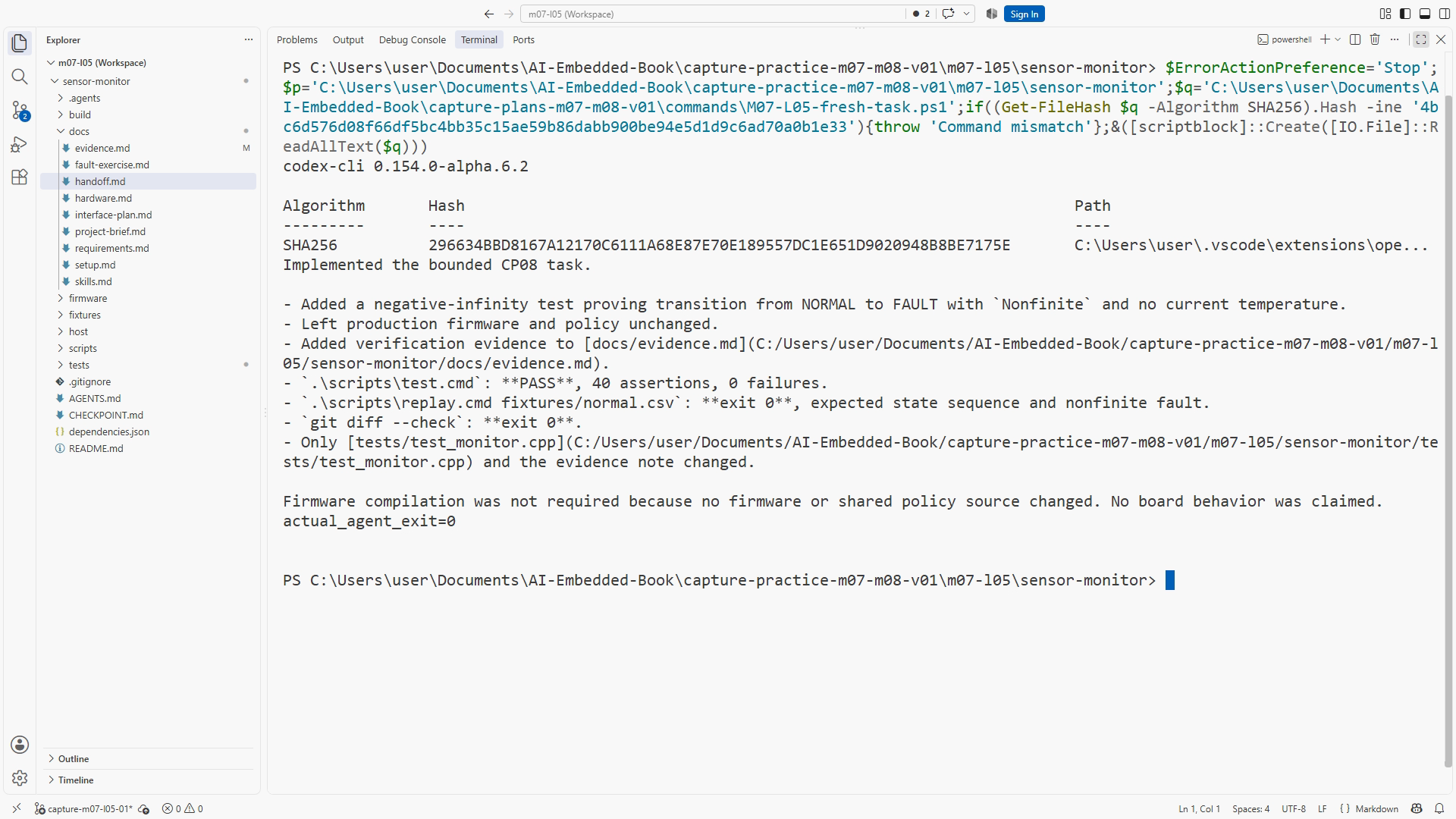
The required case proves that negative infinity produces FAULT/nonfinite with no current temperature. The existing code already promises this behavior. Use an independent monitor or ordered injected timestamps so the case does not accidentally depend on previous recovery state. Do not implement capstone features in CP08.
Observe actual context inspection, bounded edits, command use, and result interpretation. The agent's plan to test is not a command result. Independently inspect the assertion and compare its expectations with the nonfinite-input requirement. Then inspect the actual output from the available test wrapper.
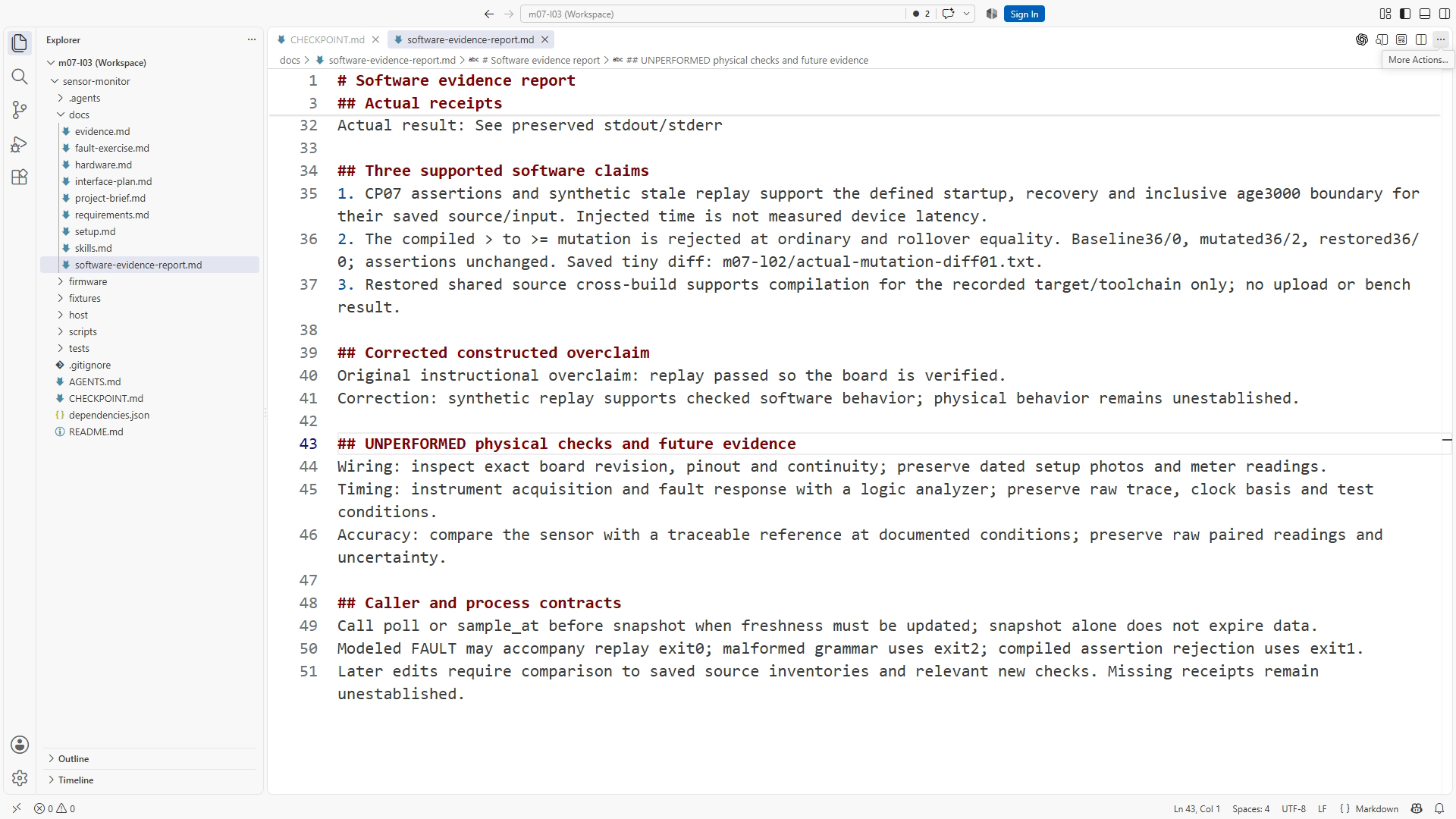
If the handoff claims prior checks passed without accessible receipts, find those records or mark the claim unestablished. A new independent check can establish the present artifact; it does not recreate an earlier unrecorded run. Preserve the distinction in the evidence note.
Update the handoff with current source identity, completed test change, relevant results, remaining limitations, and one next task. The capstone can now be named as future work. The challenge passes on actual behavior and evidence, not on the length of the final summary or a completion button.
Resources and completion
Read Chapter 15–16 and the matching Sensor Monitor checkpoint README, requirements, and evidence notes. Project paths are relative to its root. Figures: SS16-04, SS15-05. Attempt the exercise, preserve actual results, then use the separate instructor answer key.
Source resources: Chapter 15; Chapter 16; checkpoint and recovery map. Use the README and requirements inside your named checkpoint; the repository's final CP09 files include features absent from earlier stages.
Recording transcript
This challenge asks whether your repository can carry a useful task into a new session. We will add one meaningful assertion, verify it, and leave a handoff with real receipts. Start with a fresh checkpoint-eight copy. If you already tried the negative-infinity extension in an earlier lesson, preserve that work separately and use the supplied starting checkpoint for this reproducible exercise.
Read the handoff before opening the agent task. It asks for an assertion proving that negative infinity produces fault with a nonfinite error and no current temperature. Production behavior should remain unchanged. The normal and fault requirements already promise that nonfinite input is invalid, so this task strengthens verification of an existing contract rather than adding a new feature.
Check the starting project status and source identity. The expected stage has normal and fault behavior, replay, and basic assertions. It has no configurable threshold, hysteresis, or command parser. If the task starts discussing those features, it may be reading the wrong checkpoint or broadening the work beyond the handoff. Establishing the current state prevents that confusion early.
Start a genuinely fresh agent session in the project root. Ask it to complete the handoff using repository context. Do not paste the solution or exact command sequence into the prompt. A continued conversation can already contain those details, which would weaken the test of whether the repository supplies the information needed to resume.
Observe actual context inspection. The task should find the handoff, project guidance, README, applicable requirements, and relevant test source. A final summary that sounds informed does not prove which files were used. Preserve the available file-read or tool evidence. If the interface does not expose part of that process, record the limit rather than inventing it.
Now inspect the proposed test. Negative infinity is a nonfinite value, and the expected state is fault with a nonfinite error. The current flag must be false. A separate monitor instance is a simple way to isolate the case from earlier recovery state. Carefully ordered injected timestamps can also work, but the assertion should not accidentally depend on the preceding test's history.
The distinction between policy and output matters here. The new assertion checks state, error, and availability. Existing output checks handle how an unavailable temperature is serialized as JSON null. Do not claim the new policy assertion alone tested every output field. Each check should have a clear purpose so later maintenance can preserve its meaning.
Watch the scope of the edit. The intended result is a small addition to the test harness, plus an appropriate evidence or handoff update. A large production refactor is not required to add coverage for behavior that already exists. If the new test unexpectedly fails, preserve the discrepancy and diagnose it against the requirement before deciding whether production code needs a separate correction.
The task should run the relevant documented test command, and any additional check justified by the actual change. An announced intention to run tests is a plan. A command with an actual process result is execution. Save the output and source identity. A confident sentence that tests passed is not enough when there is no accessible receipt behind it.
Independently review the diff after the agent finishes. Confirm that the expected values come from the nonfinite requirement and that unrelated files remain untouched. Read the actual test result. If you perform an additional independent run, record it as your verification. It can establish the artifact's current behavior, but it does not retroactively prove the agent executed a command it only announced.
Suppose the handoff claims that earlier checks passed but points to no evidence. Search the appropriate result location. If the receipt cannot be found, mark the claim unestablished. A new run can provide current evidence, but the record should not pretend to recreate an earlier unrecorded observation. This is a common place where an unsupported claim can otherwise be copied indefinitely.
Update the handoff with the current source identity, the completed bounded test change, relevant command results, remaining limitations, and one next action. The capstone can be named as future work. Do not describe its alert or parser behavior as already implemented in checkpoint eight. A concise accurate handoff is more useful than a long summary that mixes stages.
Your challenge submission includes the fresh prompt, actual task evidence, changed assertion, reviewed diff, command results, independent review, and updated handoff. Use the answer key after attempting the work. Grade the outcome and evidence rather than exact wording. Another model may explain the same correct action differently, and a polished explanation can still lack a required action.
Keep the assertion's input visible. Use the standard numeric-limits expression for negative infinity rather than a magic bit pattern that depends on an unstated representation. The requirement is about a nonfinite numeric value, and the test should communicate that intent directly. A reader should understand the case without decoding a special constant.
If an account limit or missing tool prevents execution, preserve the prepared task and static review. Mark the runtime gate open and identify the exact dependency. Do not substitute the supplied reference result for your own missing run. The written work can remain useful while the behavior test is incomplete, and the record should make those statuses clear.
Pause here to complete the challenge and then take the module quiz. The recommended quiz target is four correct answers out of five, with unlimited retry and explanations. Quiz progress is separate from the practical evidence. A completion button cannot establish that the test was meaningful or that the fresh session used the repository correctly.
When you finish, explain what the handoff achieved. A successful run found the right task from repository context, made a bounded requirement-based test change, performed relevant verification, and left current evidence for the next session. That is a practical form of continuity. You are now ready to apply the same discipline to the larger capstone without losing the boundaries that made this small task reviewable.
Download transcript